JNT 04 · Joinery
Frustum butterfly
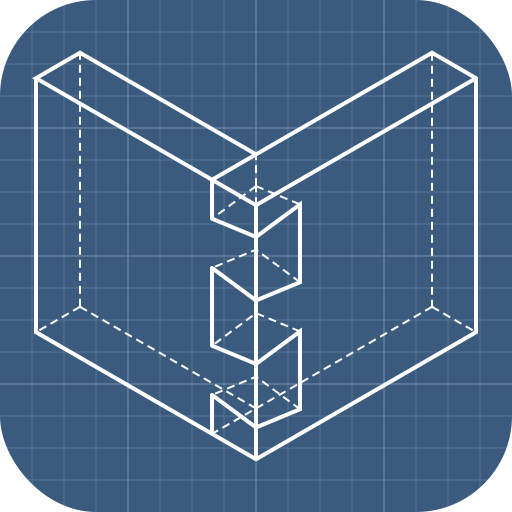
A butterfly key across a crack, wider at its bottom than at its top: it holds the crack and cannot lift out, without glue.
A crack in a wide board or a slab is often held with a butterfly: a key shaped like a bowtie, inlaid across the crack in a recess of the same shape. Its wide ends sit either side of the crack and its narrow waist across it, so the two sides cannot move apart. But its sides are straight, so only glue keeps it in its recess: pulled up, it would come straight out.
The frustum butterfly is wider at the bottom than at the top. Its sides lean outwards as they go down, so it is a dovetail in its depth as well as in its outline, and it cannot lift out either. Its ends stand upright: they are end grain, and wood cannot be compressed along its grain. Like the frustum tenon, it cannot be fitted the usual way: the butterfly is compressed across its grain to enter its recess and swells back inside it.
How it holds
- Connects
- The two sides of a crack, or boards edge to edge
- Holds by
- A bowtie key whose sides flare out, in its outline and in its depth
- Assembly
- Key compressed across its grain to enter, then recovered in its recess
- Glue, fasteners
- None
- Origin
- Based on the butterfly key, or bowtie, known in Japan as chigiri
Interactive model
Turn the joint around, play its assembly and change its proportions in the settings. Drag to rotate, scroll or pinch to zoom, and right-drag or drag with two fingers to pan.