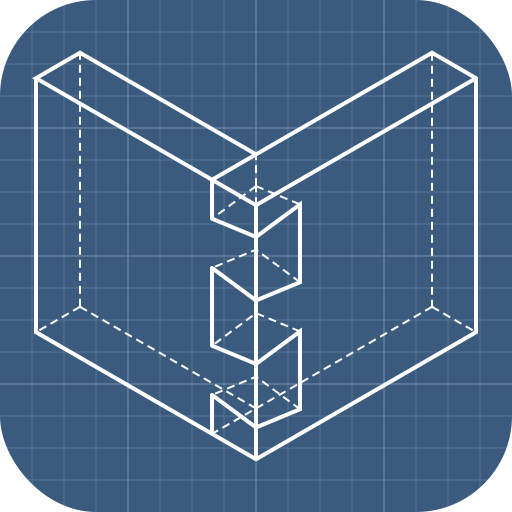
JNT 02 · Joinery
Frustum tenon
A tenon that widens towards its end, wedged into its mortise: a form fit in all three dimensions that tightens itself.
The frustum tenon is a glue-free mortise and tenon joint. Its tenon is a frustum, a cone or pyramid with its top cut off, that widens towards its end, so it wedges securely into a mortise of the same shape. The result is a form fit in all three dimensions and a connection that tightens itself.
The tenon can be rectangular or round, and made as a stub tenon hidden inside the part or as a through tenon that shows on the outside, depending on the design. Like the impossible dovetail, it cannot be assembled conventionally: the tenon is compressed to enter its mortise and recovers inside it.

How it holds
- Connects
- Rails, stretchers and dividers to legs and sides
- Holds by
- Flared tenon in a matching mortise
- Shapes
- Rectangular or round; stub or through
- Glue, fasteners
- None
Interactive model
Turn the joint around, play its assembly and change its proportions in the settings. Drag to rotate, scroll or pinch to zoom, and right-drag or drag with two fingers to pan.
Used in
- FRN 01 Impossible bench A solid wood bench with impossible dovetails between the seat and the legs, and frustum tenons holding the stretcher. Seating Details
- FRN 02 Wall cabinet A solid wood wall cabinet with impossible dovetails on the casing and frustum tenons holding the divider and back panel. Storage Details
- FRN 04 Bookshelf A standalone solid wood bookshelf without a back: impossible dovetails at the top, and every shelf held by frustum tenons through the sides. Storage Details