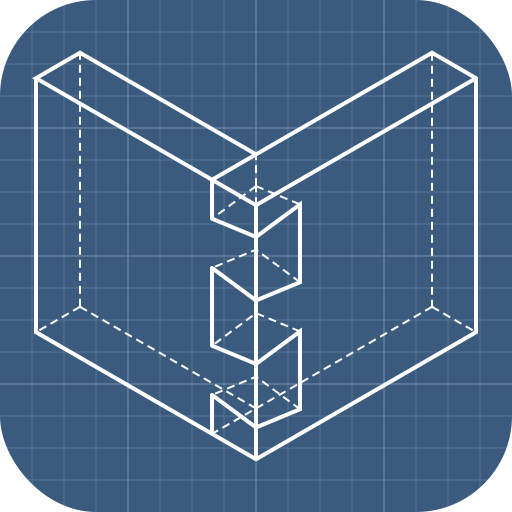
JNT 07 · Joinery
Sliding dovetail
The end of one board slid along a dovetail into a housing across the middle of another: it holds the two together across the joint, without glue.
The sliding dovetail joins the end of one board to the middle of another, as a shelf or a partition to the side of a case. Along the end of the shelf runs a dovetail, wider at its end than at its root, and across the side a housing of the same section, wider at its bottom than at the surface. The shelf slides in from the back and then holds the side in every direction but the one it came in: the side cannot be pulled off it or bow away from it, which a plain housing cannot prevent.
Along the joint, both boards run across their grain, so they swell and shrink together and the joint needs no room to move. The housing is usually no deeper than a third of the side, and its walls lean by about 10 to 15 degrees. A long joint fitted tight from end to end jams before it is home, so the housing is often tapered: a millimetre or two narrower at the front than at the back. The shelf then slides in freely and only wedges tight over its last few centimetres.
It can run through, showing its section at the front edge, or stop short of it, with the dovetail cut back to match, so the joint is hidden. A dovetail on the top face only, with the underside straight, is easier to fit by hand. The same joint holds battens across the underside of a tabletop, keeping it flat while it moves.
How it holds
- Connects
- Shelves, partitions and battens to the face of a board, across its grain
- Holds by
- A dovetail along the end of the shelf in a matching housing across the side
- Assembly
- Slid in from the back; tapered, it tightens over the last stretch
- Glue, fasteners
- None
- Origin
- Traditional in casework; in German a Gratverbindung, and across a tabletop a Gratleiste
Interactive model
Turn the joint around, play its assembly and change its proportions in the settings. Drag to rotate, scroll or pinch to zoom, and right-drag or drag with two fingers to pan.
Used in
Not in a piece of furniture yet.